

New Mexican Study Confirms that Prohibition Doesn’t Work
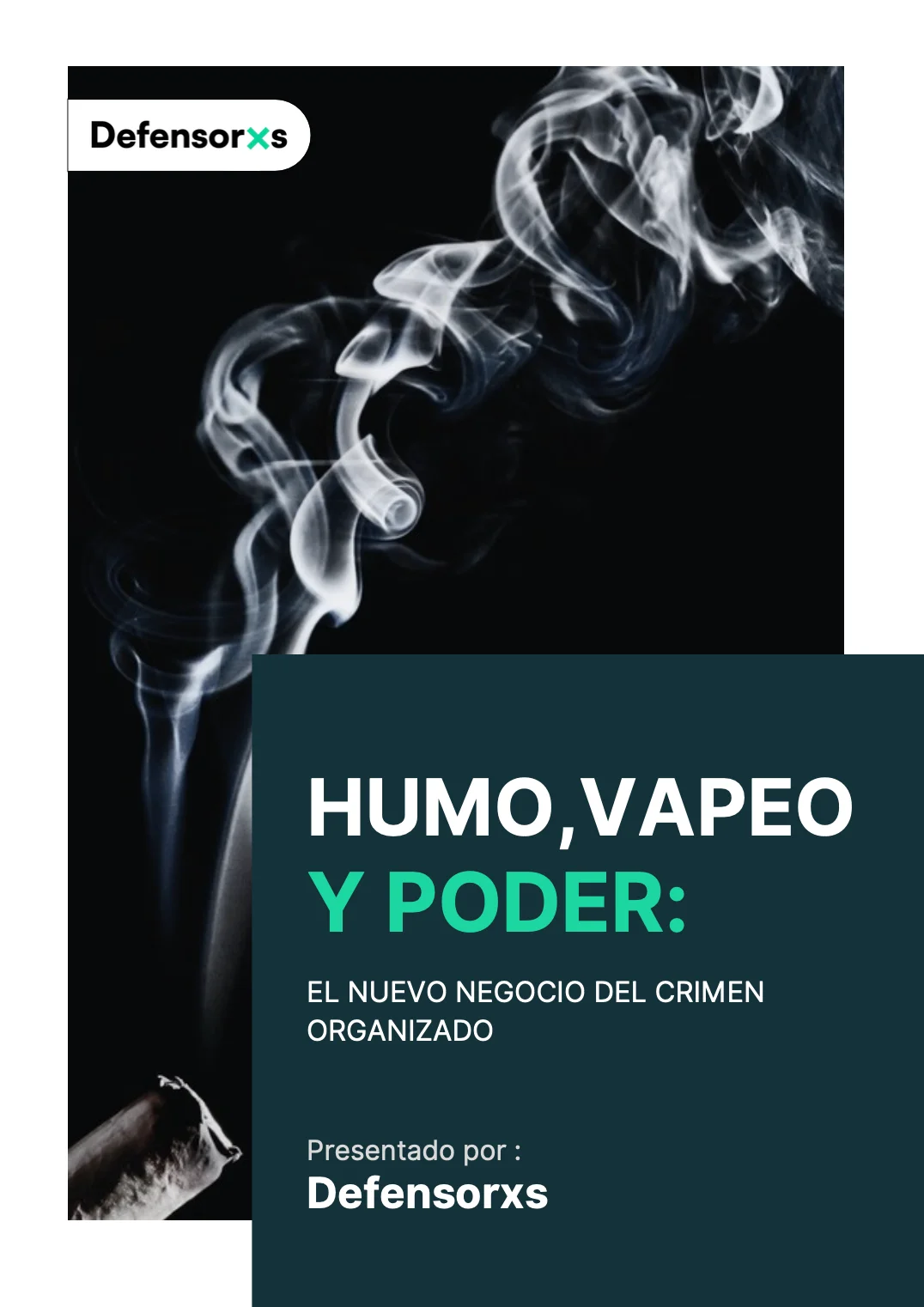

Earlier this year, the Prohibition Does Not Work (PDNW) groundbreaking report, "Vapes & Violence: Mexico's Prohibition Problem. set out the economic and public-health consequences of Mexico’s ban on lifesaving smoking alternatives and the rapid growth of the illicit market. This week, a new study by the Mexican human-rights organisation Defensorxs, Humo, Vapeo y Poder (“Smoke, Vaping and Power”), now provides an independent and deeply detailed confirmation of our central conclusion: prohibition has unleashed a human rights tragedy through strenghthening organised crime while doing nothing to reduce demand for nicotine.
Drawing on field interviews, crime data, and route mapping, Defensorxs finds that illicit cigarettes and vapes have become a significant revenue stream for seven major cartels, including CJNG, the Sinaloa Cartel, the New Michoacán Family, Cárteles Unidos, the Gulf Cartel, the Northeast Cartel, and La Unión Tepito. The report estimates that two out of every ten cigarettes consumed in Mexico are illicit, representing a market worth roughly 15–20 billion pesos annually—funds that bypass public revenues entirely and instead reinforce the operational capacity of criminal groups. This directly corroborates PDNW’s earlier warning that fiscal overreach and outright bans create high margins for traffickers and push consumers toward illegal suppliers rather than safer, regulated alternatives.
The findings on vaping are especially striking. Because vapes are prohibited, the product has become what traffickers describe as “ideal merchandise”: high demand, high value, compact, easy to conceal, and—crucially—associated with far lower legal penalties than drugs or weapons. Interviewees describe how vapes are now moved through the same channels as firearms and fentanyl precursors, yet carry a fraction of the risk. One trafficker quoted by Defensorxs remarks that whoever banned vapes “is my idol” because the profits are strong and prosecution unlikely. In some regions, minors are recruited to sell devices in schools and neighbourhoods because enforcement disproportionately targets adults. This precisely reflects the substitution effect PDNW outlined: when lower-risk products are outlawed, the market does not disappear—it is captured by those already proficient in illicit logistics.
A further implication—one of increasing concern to U.S. authorities—is the cross-border dimension. Defensorxs documents how several cartels now use established narcotics and weapons routes to move illicit vapes and tobacco northward, taking advantage of the fact that U.S. retail prices and enforcement disparities create profitable arbitrage opportunities. As Mexico’s black market expands, U.S. states may therefore find themselves importing not only illicit products but the organised-crime structures that accompany them. This underscores that Mexico’s prohibitionist approach is not a self-contained policy failure; it is a regional security risk.
The report also details a broad expansion of extortion schemes linked to the illicit nicotine market wheresmall retailers have become easy targets for both corrupt officials and criminal “protection” rackets. Defensorxs describes cases where police plant vapes during inspections, seize goods worth millions of pesos, and threaten prosecution to extract bribes. Cartel-run “insurance departments” impose quotas and penalties, turning everyday commerce into a venue for systematic abuse. For a human-rights organisation, this is the heart of the problem: prohibition has created incentives that normalise extortion, fuel recruitment of minors, and channel billions into violent groups.
Taken together, the PDNW report and Humo, Vapeo y Poder offer two perspectives on the same reality. From public health, economics, security, and human-rights standpoints, the conclusion is identical: prohibition does not work. It has enriched violent actors, harmed consumers, and undermined the rule of law. A shift toward risk-proportionate regulation—legal, taxed, and enforced against organised crime rather than ordinary citizens—is not merely preferable. It is now a matter of public safety.
Stay up to date
Join our mailing list for expert insights and global updates.
