

WHO Admits Europe Is Failing — Yet Still Ignores Harm Reduction
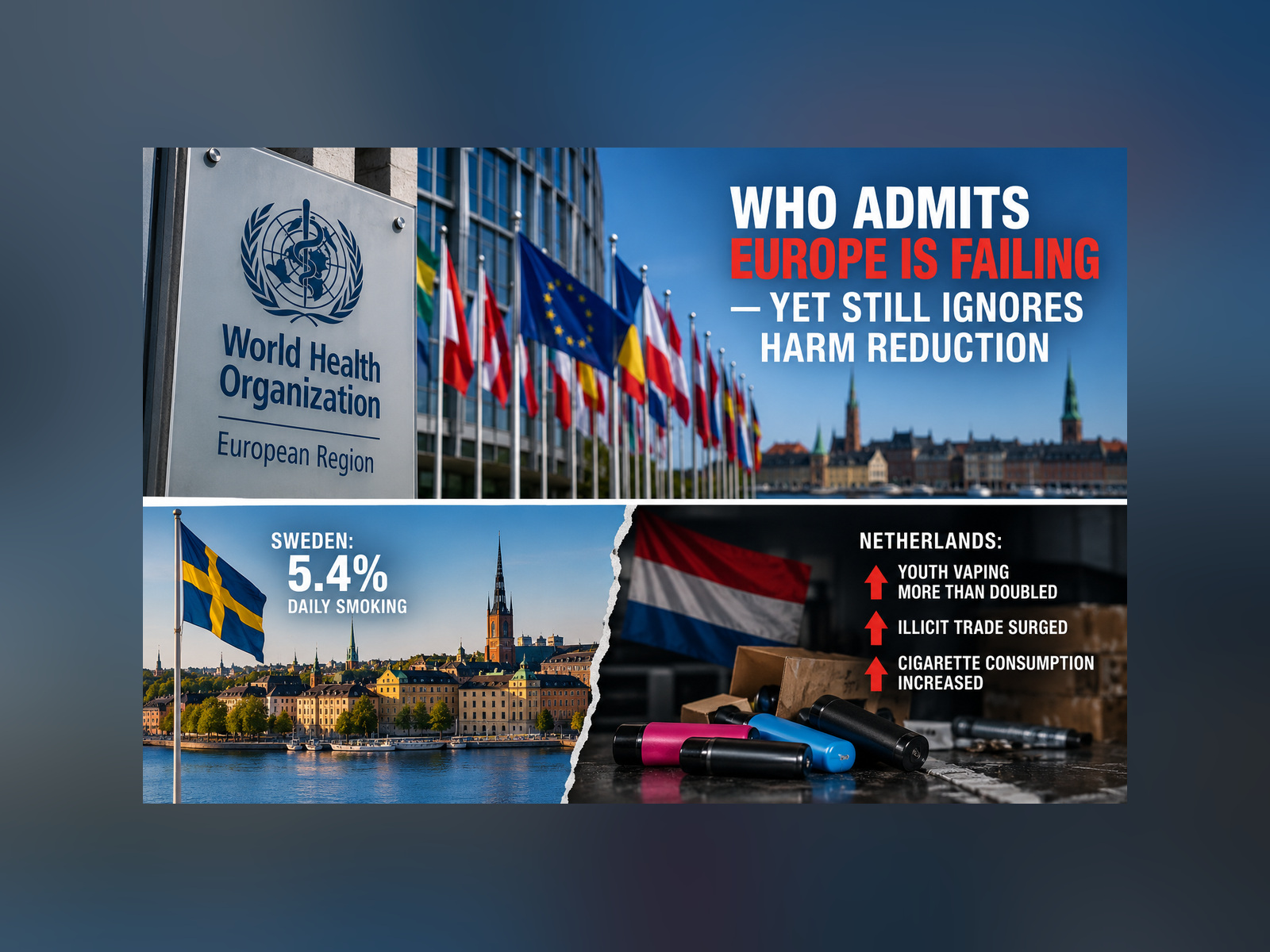

The World Health Organization (WHO) has admitted what we have been arguing all along - that Europe is failing to meet its public health targets. Yet rather than learn from countries successfully reducing smoking, it appears determined to double down on the same failed policies.
Ahead of its October 27–29 European Regional Committee meeting in Copenhagen, the WHO has published a briefing document acknowledging that Europe is not on track to meet its 2030 targets for reducing noncommunicable diseases, including cancer and cardiovascular disease.
Smoking remains a major contributor to these deaths. But while the WHO continues pushing a radical ideological agenda of prohibition, restrictions and punitive taxation, the most successful European countries have demonstrated a better way.
Sweden has reduced daily smoking to under five percent making it effectively Europe’s first smoke free country. Its success has been aided by the widespread availability of safer alternatives to cigarettes, including snus and nicotine pouches. Meanwhile, countries with severe restrictions – the very restrictions the WHO promotes – have seen falls in smoking rates stagnate. By comparison, the latest WHO-derived data put current tobacco use across the EU at around 26%, rising to around 30% or more in countries including Bulgaria, Croatia, Latvia, France, Cyprus, Lithuania, Hungary and Greece[AS1.1]. The lesson should be obvious: give consumers access to safer alternatives, and smoking can fall dramatically.
Yet the WHO's proposed strategy largely ignores this obvious fact. Instead, it lumps nicotine products together as public health threats, failing to distinguish deadly combustible cigarettes from lifesaving safer alternatives.
This is particularly absurd given that the WHO's own document calls for greater public health innovation and evidence-based solutions.
Apparently, innovation is welcome — unless it offers smokers an alternative to cigarettes.
At Prohibition Does Not Work, we have documented the consequences of precisely this approach.
Germany provides a particularly damning example of the failure of prohibition. As noted in our earlier report, despite nicotine pouches being effectively banned since 2021, consumer demand has continued to grow, with devastating consequences:
• Almost 200million Euro illicit market: Prohibition has failed to eliminate demand, instead driving consumers toward unregulated suppliers.
• More than 1,300 online sales channels have been identified, with some products containing as much as 150 mg of nicotine per pouch.
• No age verification due to the black market : Only 4% of sponsored social media posts for illicit products indicated they were intended exclusively for adults, while none of the surveyed German websites employed proper third-party age verification at purchase or delivery.
• Smoking rates remain stubbornly high: Germany still has approximately 17 million smokers, with smoking prevalence barely declining from 25% in 2017 to 24% in 2023, contributing to an estimated 140,000 smoking-related deaths annually.
The consequences are equally alarming in the Netherlands. A PDNW report reveals that since the country's 2024 vape flavour ban:
• Youth vaping has more than doubled, rising from 3.7% to 7.6%, despite the ban supposedly being introduced to protect young people.
• More than half of adult consumers have turned to foreign or illicit suppliers to obtain their preferred products.
• Cigarette consumption increased by approximately 60 million cigarettes in 2024, undermining efforts to reduce smoking.
• 27% of former vapers reported smoking more or taking up smoking following the ban.
These are not the outcomes of successful public health policies. Prohibition has driven consumers underground, failed to stop youth vaping, and undermined efforts to move smokers away from deadly combustible cigarettes.
European governments meeting in Copenhagen must demand that the WHO's next strategy seriously examine Sweden's success, distinguish smoking from other nicotine consumption, and recognise tobacco harm reduction as an essential tool for reducing disease.
The WHO cannot simultaneously admit its targets are being missed and refuse to examine what is working.
The objective should be fewer smokers, fewer deaths, and less disease, not fewer consumer choices. If the WHO was serious about saving lives, it would accept the evidence, admit its prohibitionist approach has failed, and would embrace reduced risk products as the solution to Europe’s smoking rates they are.
Stay up to date
Join our mailing list for expert insights and global updates.
